
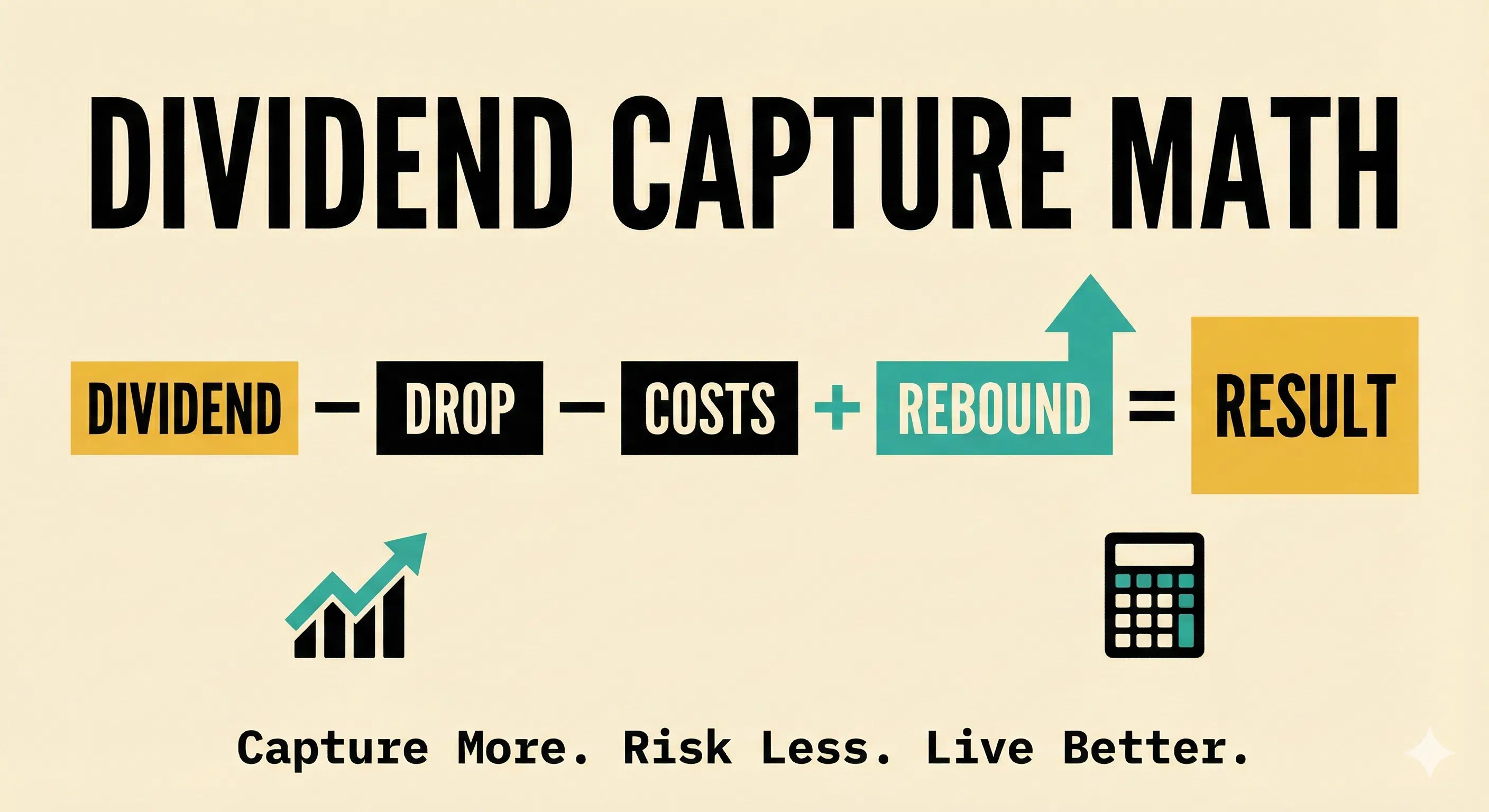
Quick answer: Dividend capture math is comparing what you earn (the dividend) against what you lose (price drop + costs + taxes) and what you regain (price rebound). If rebound + dividend beats drop + costs, the trade works.
Important: Educational only — not financial or tax advice. Results vary by ticker, market conditions, and taxes/fees.
Want the “protect your butt” details? This post covers the math framework. The book covers the rules: candidate filters, entry/exit plans, and risk controls that keep math from becoming “math-ish regret.”
Dividend capture isn’t free money (so let’s do the real math)
Here’s the truth that saves you months of frustration:
- The dividend is real cash.
- The price reaction around ex-div is also real.
- Your costs (spread, slippage, taxes) are brutally real.
So the goal is not “collect a dividend.” The goal is:
Collect a dividend in a situation where the price drop is manageable and recovery is likely.
The simplest dividend capture equation
Use this as your mental calculator:
Result ≈ Dividend − Price Drop − Trading Costs − Taxes + Price Rebound
It’s not perfect (markets aren’t polite), but it’s the right framework.
Define the pieces (plain English)
- Dividend: the cash paid per share.
- Price Drop: how much price falls around ex-div (often roughly dividend-sized, sometimes more, sometimes less).
- Trading Costs: commissions (if any), plus spread/slippage (almost always).
- Taxes: depends on your situation and holding period. Short holds can reduce tax advantages.
- Price Rebound: how much price recovers after ex-div during your holding window.
A quick example (with friendly numbers)
Let’s say:
- You buy at $50.00
- Dividend is $0.50
- Price drops to $49.60 around ex-div (a $0.40 drop)
- Your spread/slippage round-trip is $0.05 total
- You sell at $49.90 (a $0.30 rebound from $49.60)
Estimate:
- Dividend: +$0.50
- Drop: −$0.40
- Costs: −$0.05
- Rebound: +$0.30
Result (before taxes) ≈ $0.50 − $0.40 − $0.05 + $0.30 = +$0.35 per share
That’s the basic game.
Breakeven: the one number you should care about
Breakeven asks: “How much rebound do I need so this trade doesn’t stink?”
Breakeven rebound ≈ Price Drop + Costs + Taxes − Dividend
If the dividend is small and the spread is large, breakeven can get ugly fast.
Why spreads matter more than people think
If your dividend is $0.20 and your round-trip spread/slippage is $0.08, you just gave away 40% of the dividend before the trade even has a personality.
This is why Yield Raiders often prefer:
- Liquid tickers (tighter spreads)
- Clean execution (less slippage)
- A planned entry (not chasing)
How to score a setup in 60 seconds
Before you trade, ask:
- Dividend size: meaningful enough to matter?
- Typical ex-div drop: historically smaller than the dividend, roughly equal, or worse?
- Recovery speed: does it tend to bounce in your holding window?
- Costs: will spreads/fees eat the edge?
- Landmines: earnings/news nearby?
FAQ
Should I only trade stocks that drop less than the dividend?
Not necessarily. Some trades work because rebound is fast. The key is that your expected rebound + dividend beats the drop + costs.
Do ETFs behave differently than individual stocks?
Often they can be less volatile, but results vary. The math framework stays the same.
What’s the biggest beginner math mistake?
Ignoring spread/slippage and pretending the dividend is pure profit.
Next step
If you want the “math + rules” version — the part that keeps a good-looking setup from turning into a slow leak — the book lays out the guardrails and the repeatable decision process.
Related: What is dividend capture? | Dividend capture calendar
Related:
0 Comments