
Disclosure: This post contains affiliate links. If you sign up or buy through them, we may earn a commission at no extra cost to you. See our affiliate disclosure for details.
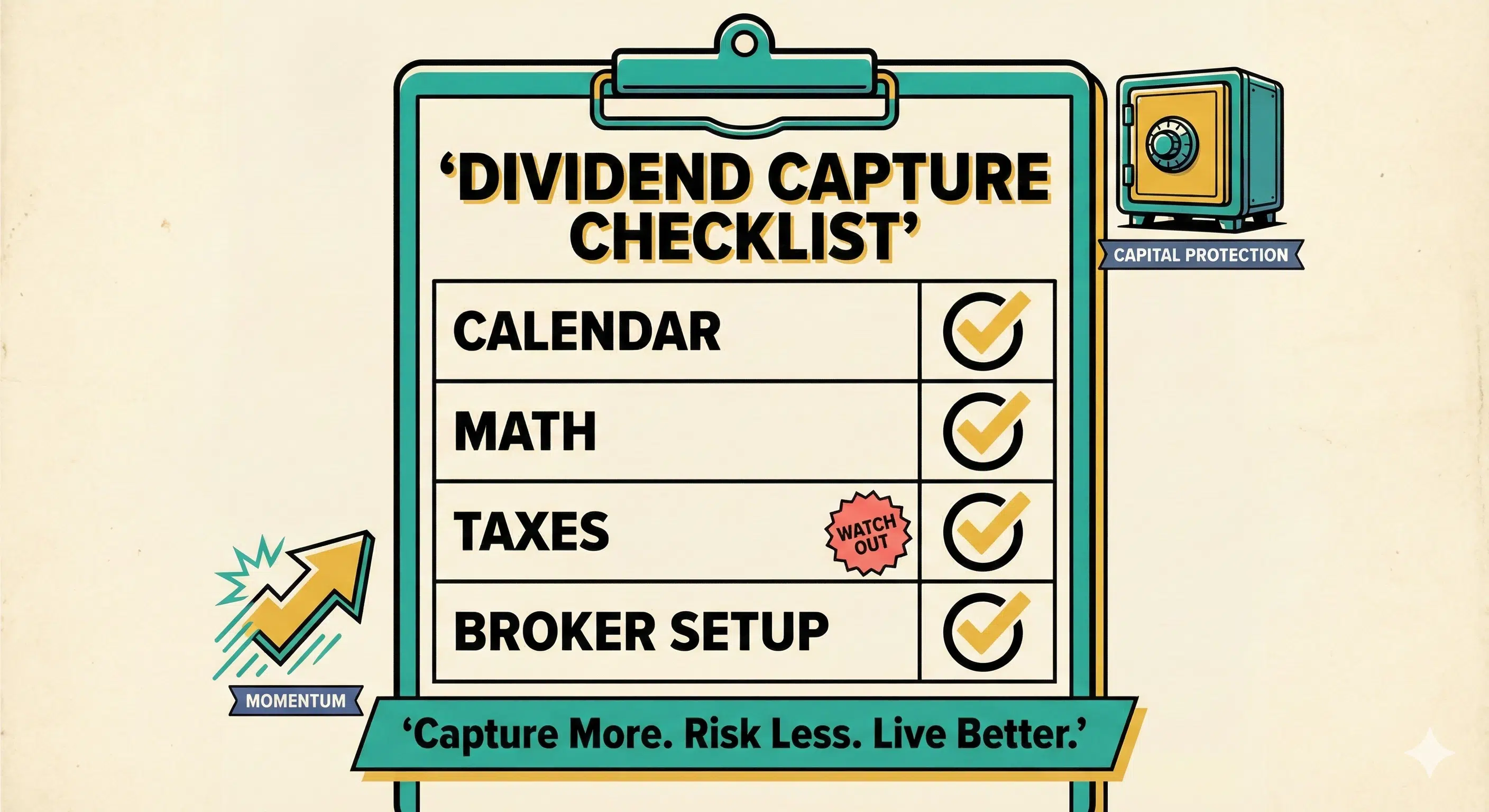
Quick answer: A dividend capture checklist is a step-by-step system for planning and executing dividend capture trades: track ex-dividend dates, estimate dividend vs drop vs rebound, note tax implications, use a broker setup that reduces friction, and follow a repeatable routine so you don’t rely on memory or luck.
Important: This is educational content, not financial advice or tax advice. Dividend capture involves risk. Always do your own research and talk to a qualified professional for tax questions.
Want the “protect your butt” details? This page ties the whole system together. If you want the guardrails—candidate rules, entry/exit discipline, risk controls, and the common mistakes that quietly eat dividends—grab the book:
How to use this checklist (so it actually helps)
Read this page once, then use it like a cockpit checklist:
- Before the week starts: calendar + candidates
- Before each trade: math + broker execution
- After each trade: log + review
Jump links:
1) Calendar Checklist (ex-div dates without chaos)
Your calendar is the spine of the whole strategy. If the dates are wrong (or missing), everything downstream gets sloppy.
Calendar checklist:
- Ex-dividend date confirmed
- Pay date noted (for cashflow planning)
- Earnings/news window checked (avoid nasty surprises)
- Entry window defined (example: 1–3 trading days before ex-div)
- Exit window defined (example: 1–5 trading days after ex-div)
Deep dive: Dividend Capture Calendar: track ex-div dates without losing your mind
2) Math Checklist (dividend vs drop vs rebound)
Dividend capture fails when people count the dividend… and ignore the price move and friction costs.
60-second math checklist:
- Dividend size: big enough to matter after costs?
- Expected ex-div drop: historically smaller/equal/larger than dividend?
- Expected rebound: does it recover within your exit window?
- Friction costs: spread + slippage + any fees (round trip)
- Breakeven: rebound needed so the trade doesn’t stink
Quick framework:
Result ≈ Dividend − Drop − Costs (and taxes) + Rebound
Deep dive: Dividend Capture Math: dividend vs drop vs rebound in plain English
3) Taxes Checklist (what to track + what to ask)
Dividend capture is often short-term, which can affect how dividends and gains are taxed depending on your situation and account type.
Tax sanity checklist (records to keep):
- Buy date / sell date (holding period)
- Entry / exit price and share count
- Dividend amount and payment record (for your log)
- Notes: earnings/news, reason for entry/exit
- End-of-year docs: 1099-DIV and 1099-B (taxable accounts)
Questions to ask your tax pro (copy/paste):
- “How does my typical holding period affect my dividend tax treatment?”
- “Does my account type change how dividend capture is taxed or reported?”
- “What records do you want from me so filing is clean?”
Deep dive: Taxes for Dividend Capture: what to know (and what to ask)
4) Broker Setup Checklist (reduce friction, reduce mistakes)
The “best broker” for dividend capture isn’t the one with 97 advanced tools you’ll never touch. It’s the one that keeps execution clean and reporting sane.
Broker checklist for dividend capture traders:
- Reliable limit orders (easy to place, easy to manage)
- Good execution and reasonable spreads on your tickers
- Clear dividend visibility (history + distributions)
- Clean tax reporting / exportable history
- Watchlists + alerts (optional but helpful)
Deep dive: Best Brokers for Dividend Capture: what actually matters
5) The Repeatable Weekly Workflow (the dividend capture trader routine)
This is the part most people skip… and it’s why they end up “winging it.” Don’t wing it. Use a routine.
Weekly (15–30 minutes)
- Pull ex-dividend dates for the next 2 weeks (watchlist only).
- Flag earnings/news conflicts in the capture window.
- Select a short candidate list (example: 5–15 tickers) that match your comfort level.
- Set your entry and exit windows.
Daily (5 minutes)
- Check today/tomorrow ex-div dates for your candidates.
- Scan for “uh-oh” events (earnings moved, big news, abnormal volatility).
- Only trade if your checklist is green.
Before every trade (2 minutes)
Pre-trade checklist:
- Ex-div date confirmed
- No earnings landmines in your window
- Dividend is worth it after costs
- Entry plan exists (not chasing)
- Exit plan exists (window + risk rule)
- Position size won’t wreck your week if it misbehaves
After every trade (3 minutes)
- Log the outcome (dividend, price move, costs, days-to-recover).
- Write one sentence: “What would I do differently next time?”
If you only do ONE thing: Use the pre-trade checklist before you click Buy. It prevents most expensive mistakes.
Related cornerstone
If you’re brand new to this strategy, start here first:
FAQ
Is dividend capture a “set it and forget it” strategy?
No. It’s simple, but timing-sensitive. The checklist and routine keep it manageable without turning it into a second job.
Can I do dividend capture with ETFs?
Often yes, and some traders prefer ETFs for diversification. The same checklist still applies: dividend vs drop vs costs vs rebound.
Should I do dividend capture in a taxable account or retirement account?
That depends on your personal situation. Tax treatment and reporting can differ by account type. If taxes are a big concern, ask a tax professional.
What’s the most common beginner mistake?
Counting the dividend as profit while ignoring the ex-div price drop and trading friction (spreads/slippage).
Next step
This checklist is the system map. If you want the full “protect your butt” playbook—rules, guardrails, and the practical decision process—grab the book:
Related:

0 Comments